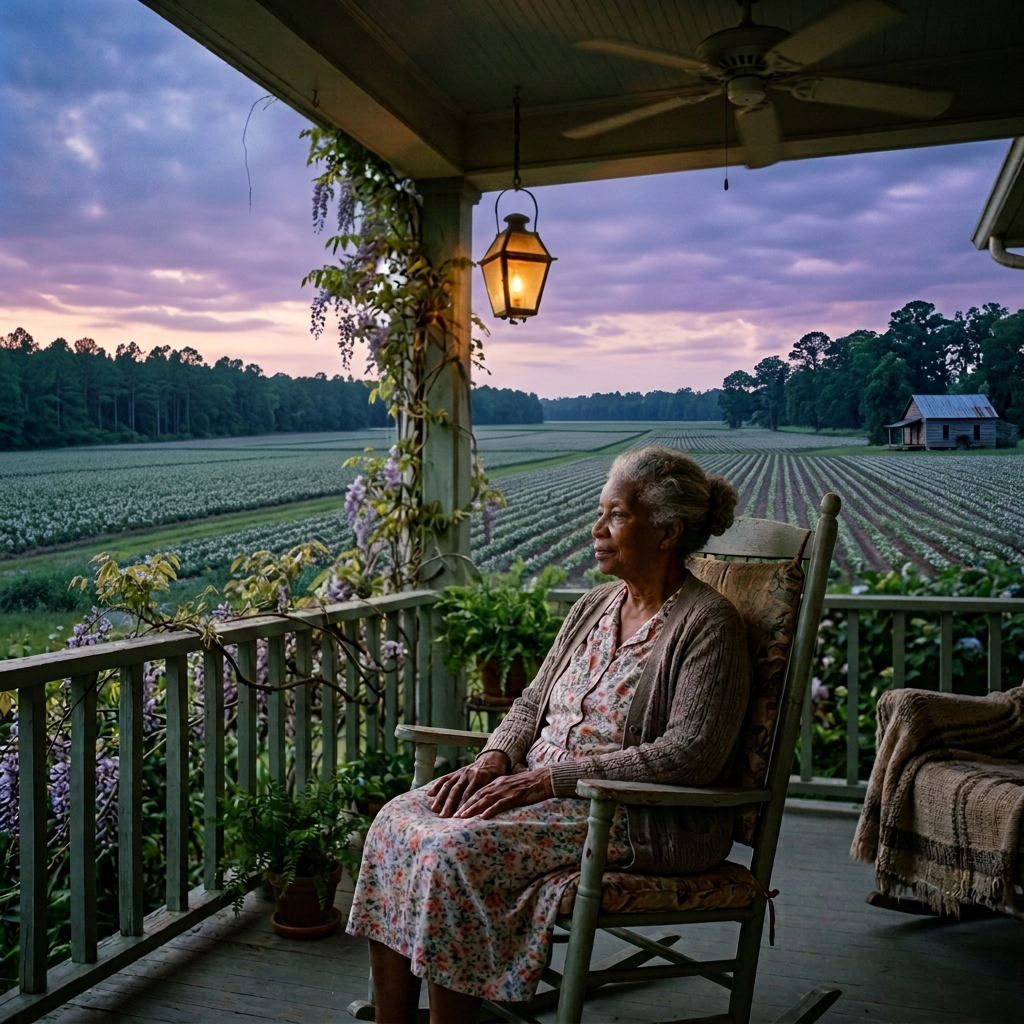
Every afternoon, when the Delta sun finally surrendered to evening, the whole world seemed to exhale.
The heat that had pressed itself against the fields all day began to loosen its grip, rising in long, trembling waves that blurred the distant treeline. A languid breeze, as if granted sudden permission, drifted through the cotton rows, setting the bolls to nodding. Across the gravel roads, shadows lengthened and deepened, turning the pale stones the soft, burnished color of old copper left out in the weather. Overhead the sky performed its quiet alchemy—blazing gold softening into the tender flush of peach, then deepening to lavender, until the first stars stepped forward one by one, shy and deliberate, claiming their places in the darkening vault.
From the high limbs of the pecan trees, mockingbirds kept up their restless arguments, voices sharp and theatrical against the gathering dusk. Cicadas raised their ceaseless summer hymn, a metallic drone that seemed to rise from the earth itself, while down by the bayou the tree frogs began their evening tuning—soft, liquid notes that trembled on the humid air. Somewhere far off, an old screen door slapped shut with the familiar authority of habit, and a moment later came the low, contented rumble of a pickup easing home along the rutted lane after another long day among the rows. The evening carried its own perfume: the deep, mineral scent of warm earth, the sweet-green sharpness of fresh-cut hay, the heady breath of honeysuckle climbing a leaning fence, and, somewhere close, the rich, savory promise of supper frying in a cast-iron skillet.
Miss Loretta’s porch waited exactly where it always had, catching the last, honeyed rays of light. Its weathered pine boards, silvered by decades of sun and rain, held the soft impressions of countless footsteps—family, neighbors, and the occasional stranger who somehow never remained a stranger for long. The wood had been polished smooth by years of coming and going, by the weight of shared stories and the quiet company of those who knew the value of simply sitting still.
The porch swing moved with an easy, unhurried rhythm, its rusty chains singing a low, familiar song that every soul in the Delta seemed to carry in the marrow of their bones. Beside it, Miss Loretta settled into her wicker chair as though the seat had been shaped for her alone. Her church fan moved in a slow, steady arc, stirring the heavy air, the sweet tea sweating in her glass, and the warm, half-forgotten memories that rose with the evening. Whatever small breeze the Lord chose to send found its way across her lap and drifted on.
She smiled the moment she saw you walking up the dusty lane— a smile that reached her eyes and softened the lines time had drawn there.
“Baby,” she called, her voice carrying easily on the still air, “come on up here. The pie’s still warm, and the Delta’s been busy all day.”
She handed you a generous slice of apple pie on a plain white plate. The buttery crust flaked at the lightest touch, releasing the deep, spiced fragrance of cinnamon and slow-baked apples into the cooling evening. Thin threads of steam curled upward and vanished among the first fireflies, who had begun to blink their soft green lanterns into life around the porch posts and the low-hanging branches.
You settled into the swing. It creaked beneath you—not with complaint, but with the companionable sound of an old friend clearing its throat, ready to listen. The first bite of pie melted on your tongue, tart and sweet and fragrant with summer.
Because everybody in the Delta knew one quiet, unchanging truth:
The sweetest pie always came with the best stories.
And Lord…
Miss Loretta always had another one waiting.
Miss Loretta was born Loretta Mae Jenkins in the late spring of 1947, in a narrow shotgun house that leaned a little toward the bayou, as if it too were listening for the water. Her people had worked the same stretch of Delta land since before the Great Flood of ’27, first as sharecroppers, later as the stubborn owners of forty hard-won acres of cotton and a few rows of pecans. She came into the world while the evening heat still clung to the screens and the cicadas had already begun their long summer song. Her mother used to say the child arrived with the smell of warm earth already in her hair.
She grew up knowing the exact weight of a full cotton sack, the particular green of a storm sky over the fields, and the way a porch could hold a whole day’s worth of talk once the sun finally let go. Her father was a quiet man who spoke mostly with his hands—planting, mending, carving small wooden birds that still sit on her mantel. Her mother kept the family stories the way some women keep recipes: carefully, completely, and ready to be handed on. Loretta learned early that a person could starve for many things, but never for lack of a tale told right.
At seventeen she married Roy Ellis, a soft-spoken boy from two farms over who could make a fiddle cry and a truck engine forgive almost anything. They lived in a little white house with a new tin roof and a porch just wide enough for two chairs and a swing. Roy worked the land beside her father; Loretta kept the books, the garden, and the kitchen. For a handful of years the world felt almost gentle. Then came the stillbirth in the winter of ’68, and after that the long, quiet years when the house seemed too large and the evenings too empty. Roy never spoke of the child they lost. Neither did she. They simply sat on the porch night after night, letting the swing carry what words could not.
In 1979 a late-summer storm took the old home place and nearly took Roy with it. He lingered three months, then slipped away one October morning while the pecans were just beginning to fall. Loretta was thirty-two. She buried him beneath the biggest tree on the property, the one that still drops the sweetest nuts, and she stayed. People expected her to leave—to go to a sister in Memphis or a cousin in Jackson. She did not. Instead she kept the land, kept the porch, and slowly began to keep other people’s stories the way her mother had kept theirs.
She never remarried. The church ladies tried, the occasional widower tried harder, but Loretta had already given her heart once and found it did not come back empty-handed. What returned to her was a different kind of fullness: the steady company of neighbors who needed a listening ear, the children who grew up calling her Miss Loretta as if the title had been hers from birth, the strangers who stopped for directions and somehow left with a slice of pie and the sense that they had been expected all along.
Over the decades the land around her changed. Cotton gave way in places to soybeans and catfish ponds. Developers came with their glossy maps and careful smiles. Some of the old families sold. Some held on. Loretta held on harder than most. The forty acres dwindled to twelve, then to the house lot and the pecan grove, but the porch remained exactly where it had always been—catching the last light, offering the first cool air, ready for whoever walked up the lane.
She learned to bake the apple pie the year after Roy died, using fruit from the Johnson trees that still stood then. The recipe was simple. The patience it required was not. She discovered that a warm pie could open a closed mouth faster than any question, and that most people, given a quiet porch and a little sweetness, would eventually tell you the thing that was weighing on them. So she listened. She remembered. And when the stories threatened to grow too heavy, she set them down carefully among the others she already carried, the way a woman might set a precious dish on a high shelf.
Now the years have silvered her hair and softened her hands, but they have not dulled the particular light in her eyes when someone new appears at the edge of the yard. She still keeps the church fan moving, still sweetens her tea the old way, still knows which boards on the porch will creak and which will hold a secret. The Delta has taken much from her—husband, child, most of the land, nearly all the old ways—but it has left her the one thing she never asked to keep and never once thought of giving up:
the porch, the pie, and the quiet certainty that every soul who walks up that dusty lane is carrying a story worth hearing.
And so she waits, fan moving slow, smile ready, another tale already rising to meet the evening air.
Miss Loretta set her glass down with a soft click and gave the church fan one long, thoughtful stroke. The fireflies had thickened around the porch posts, and the swing still creaked beneath you like it was listening too.
She leaned in just a little, voice low and warm, the way a woman talks when the night is deep enough and the company is right.
“Well now… since you asked.”
She smiled, slow and knowing.
“You remember that new couple that moved into the old Carter place last spring? The ones with the shiny truck and the city ways? Everybody thought they were pure as morning milk. Turns out the wife’s been driving all the way to Greenville twice a week for ‘art classes.’ Art classes that somehow always end with her coming home smelling like that fancy cologne the hardware-store man wears. Her husband still thinks she’s painting sunsets. Bless his heart. The whole town’s been watching that truck leave and come back like it’s the evening news.”
She took a sip of tea, eyes twinkling.
“And then there’s Deacon Willis. You know the one—always first in the pew, always last to leave the fellowship hall. Well, last month somebody found a whole case of that cheap blackberry wine behind the baptistry. Not the communion kind, neither. The drinking kind. He claimed it was for ‘medicinal purposes.’ Sister Ernestine said if that was medicine, half the congregation needed a prescription. He hasn’t looked anybody straight in the eye since.”
A soft laugh escaped her, almost a sigh.
“And poor little Tasha down the road? Seventeen and already carrying a baby. Her mama still tells folks it was the Lord’s will. Everybody else knows it was that boy from the cotton gin who left town the week after the fair. She sits on her mama’s porch every evening just like I do, only her stories are quieter. I take her a plate sometimes. Girl’s got enough weight on her without the whole Delta adding more.”
Miss Loretta’s fan slowed.
“Then there’s the Johnson brothers. Still fighting over that strip of land their daddy left them twenty years ago. One of ’em put up a fence. The other one tore it down. Then the first one put it back up with barbed wire. Last I heard they weren’t speaking, but their dogs still visit each other every afternoon like nothing’s wrong. Animals got more sense than people sometimes.”
She glanced out toward the dark fields, then back at you.
“And of course… there’s talk about me.”
A small, private smile.
“Some say I never remarried because my heart stayed buried with Roy. Others say I just got too particular. A few of the older ones still whisper that I know things I shouldn’t—about who really set that fire at the old gin in ’84, or why the sheriff’s wife left town so sudden back in the nineties. I don’t correct them. Truth is, most of what I know walked up these steps on its own two feet and sat right where you’re sitting. People tell me things because the pie is warm and the night is long and nobody else is listening quite the way I do.”
Her fan slowed. The air seemed to still with it.
“But the story this town has never quite put down… the one that still walks the fields after dark… is the four sisters.”
Miss Loretta looked past the porch rail, past the fireflies, toward the place where the old white house used to stand.
“The Mallory girls. Grace, June, Pearl, and Ruth. Lived in that big house that caught every sunset like it had been built for the light. Four daughters, one after another, each prettier and more restless than the last. Their mama died young. Their daddy drank the rest of the way down. So the girls raised themselves on that porch and in those rooms, and the Delta watched them the way it watches anything too bright to last.”
She drew a slow breath.
“Grace was the oldest—proud, sharp-tongued, married the preacher’s boy because it looked right on paper. Six months later she left him for a guitar player who never stayed anywhere longer than a weekend. She sent postcards for a while. Then the postcards stopped.
June came next. Soft-spoken, always barefoot, always looking toward the road. She ran off with a married man from Clarksdale in the spring of ’61. Came back two years later alone, carrying a baby girl she never named in public. She raised that child in the back room and never spoke the father’s name again. Some say the child looked just like him. Some say June looked straight through anybody who tried to ask.
Pearl was the one who stayed. Pearl kept the house running when the others left. She cooked, she cleaned, she paid the taxes with money nobody could quite account for. Men came up that lane after dark—some married, some not—and left before morning. Pearl never explained and never apologized. She just kept the porch light on and the curtains drawn.
And then there was Ruth. The baby. Sixteen the September she disappeared. Wore a blue dress that day, the one with the little white buttons. Walked down the lane toward the highway while the rest of them were inside arguing about something that didn’t matter. Never came back. No note. No suitcase. No one ever saw her board a bus or climb into a car. The river was high that year. The sheriff dragged the bayou for three days and found nothing but an old boot and a tangle of fishing line. Pearl closed the front door that night and locked it. Folks say she never opened it the same way again.”
Miss Loretta’s voice had gone quiet, almost tender.
“The house burned in the winter of ’78. Lightning, they claimed. Or a carelessly dropped cigarette. Only the chimney stood for years after, like a finger pointing at the sky. Now even that’s gone—plowed under for soybeans. But the sisters remain. Not in the ground. In the talk. In the way people still lower their voices when the wind comes up from the bayou and sounds a little too much like women laughing.
Grace never returned. June’s girl grew up and moved north and does not answer letters. Pearl lived out her days in a rented room in town, thin as a rail and silent as the grave. And Ruth… Ruth is the one nobody ever stopped looking for, even when they pretended they had.”
She turned her eyes back to you, the porch light soft on her face.
“That’s the gossip that doesn’t fade, baby. The rest of it comes and goes with the seasons. But the four sisters… they stay. Every time the light gets long and the air gets heavy, somebody on some porch somewhere still wonders which one of them is still trying to come home.”
She looked at you across the soft dark.
“Pie’s gone cold, but the night’s still warm. You can stay as long as you like. The sisters ain’t the only ones who never quite left.”
The swing settled into a slower rhythm, the chains soft as a held breath. Out beyond the porch the fields had gone the deep blue of late evening, and the last of the fireflies drifted like slow sparks against the dark. Miss Loretta’s fan rested quiet in her lap now, the paper blades still.
You didn’t speak right away. The pie plate sat empty on the little table between you, a few cinnamon-flecked crumbs catching the porch light. Somewhere down the lane a dog barked once and then thought better of it. The mockingbird stayed silent.
After a while she smiled that same small, knowing smile, the one that had greeted you at the edge of the yard.
“You got that look,” she said. “The one that says the story’s still turning over in your head. Most folks do, first time they hear about the Mallory girls.”
She reached for the glass pitcher, poured a little more tea even though the ice had long since given up, and set it back down without offering. The night was doing its own pouring now—humidity and honeysuckle and the low, steady pulse of the bayou.
“You know what the Delta does with unfinished stories, baby? It doesn’t bury them. It lets them grow roots. Every time a stranger walks up this lane, every time a porch light comes on after dark, every time somebody’s truck leaves town and don’t come back the same way—it all folds into the same soil. The sisters are part of that now. Same as Roy. Same as the child we never named. Same as every quiet thing that ever sat on this porch and waited for the heat to break.”
She looked at you then, eyes catching the thin light from the kitchen window.
“So you tell me. You been sitting here long enough. You carrying something of your own, or you just come for the pie?”
The swing creaked once more, patient.
The night waited with her.

Leave a Reply